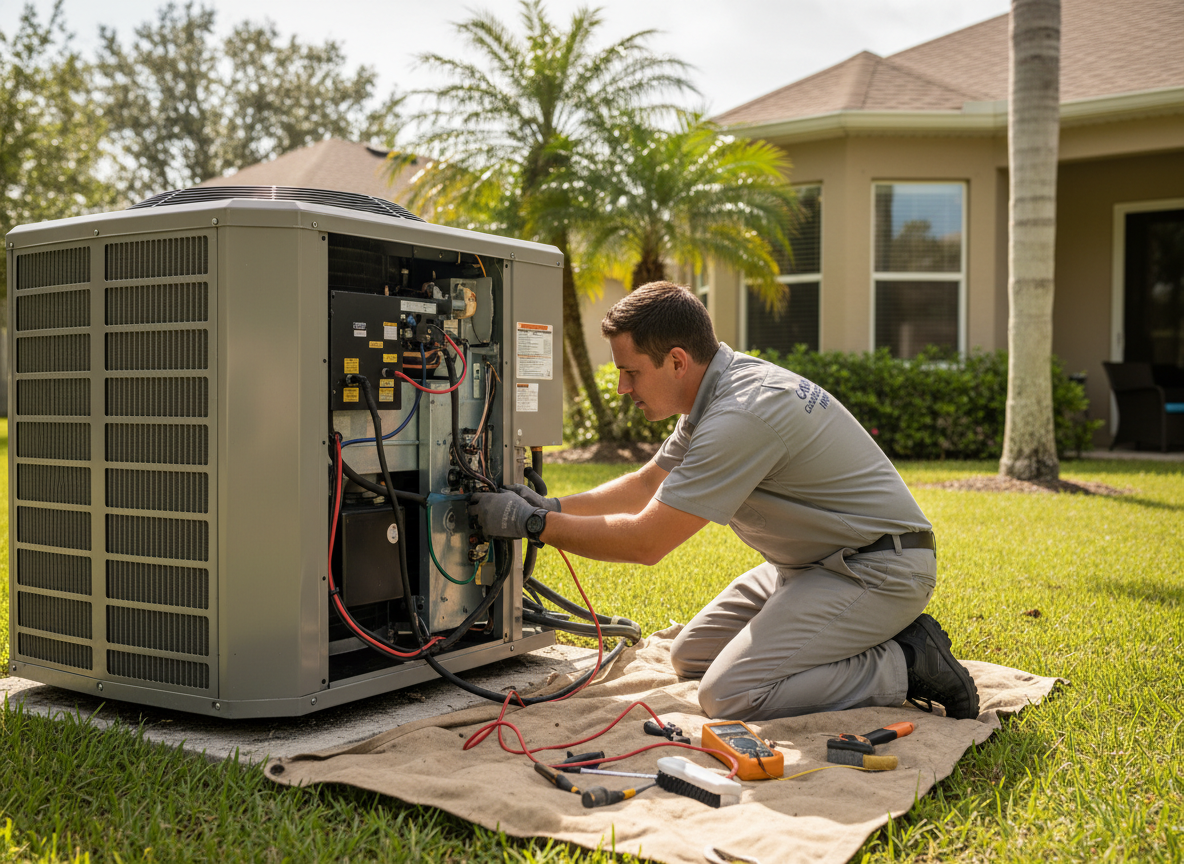
Central air systems in Lakewood Ranch homes often struggle with the persistent high humidity and summer heat that define Manatee County weather. Coils accumulate moisture that promotes mold growth inside the air handler, while outdoor condensers face pollen, dust, and occasional salt air from the Gulf that accelerates corrosion on fins and electrical connections. Technicians frequently find that homes built in the 1990s and early 2000s have older R-22 units whose refrigerant lines develop leaks at the flare fittings after years of thermal cycling.
When a compressor fails to start, the first checks are the run capacitor and contactor at the outdoor unit rather than assuming a full replacement is needed. In Lakewood Ranch, many two-story homes route return air through attic spaces where poor insulation allows heat gain that overloads the evaporator coil. Technicians also inspect the condensate drain line for clogs caused by algae, which can back up and trip the float switch, shutting the system down even when the mechanical components remain sound.
Seasonal Strain Patterns
Lakewood Ranch summers push systems to run 12-plus hours daily, wearing contactors and capacitors faster than in milder climates. Winter months bring fewer calls, yet any sudden cold snap can reveal low refrigerant levels that were masked during constant operation. Checking static pressure across the evaporator coil reveals whether the duct system was sized correctly for the home's square footage and layout.
What Technicians Check First
Start at the thermostat to confirm 24-volt power reaches the air handler, then test the outdoor disconnect for voltage drop. Next examine the capacitor microfarad rating against the nameplate and listen for the telltale hum of a locked compressor. Finally, measure temperature split across the evaporator while the system runs to verify actual cooling performance rather than relying on pressure readings alone.
Technician insight
In Lakewood Ranch the thing that catches most people out with central air repair is the algae that grows inside the condensate line because of our constant humidity; homeowners replace the capacitor three times before someone finally clears the drain and stops the float switch from shutting the system down every afternoon.
Weak Cooling in East Lakewood Ranch
A homeowner reported the system running nonstop yet failing to drop below 78 degrees. Inspection showed pollen buildup on the outdoor condenser fins plus a partially clogged drain line causing the float switch to cycle the unit. Cleaning both restored full capacity and proper condensate flow without parts replacement.
How it works
- 1
Initial Assessment
Arrive at the Lakewood Ranch address and review recent performance complaints with the homeowner.
- 2
Diagnostic Testing
Measure electrical values, temperature splits, and static pressure to isolate the fault.
- 3
Component Repair
Replace or clean the specific failed part such as a capacitor, contactor, or clogged drain.
- 4
System Verification
Run the unit through a full cycle and confirm proper operation before leaving.
Pricing
Pricing depends on the specific component and access conditions; upfront quotes are given after diagnostics.