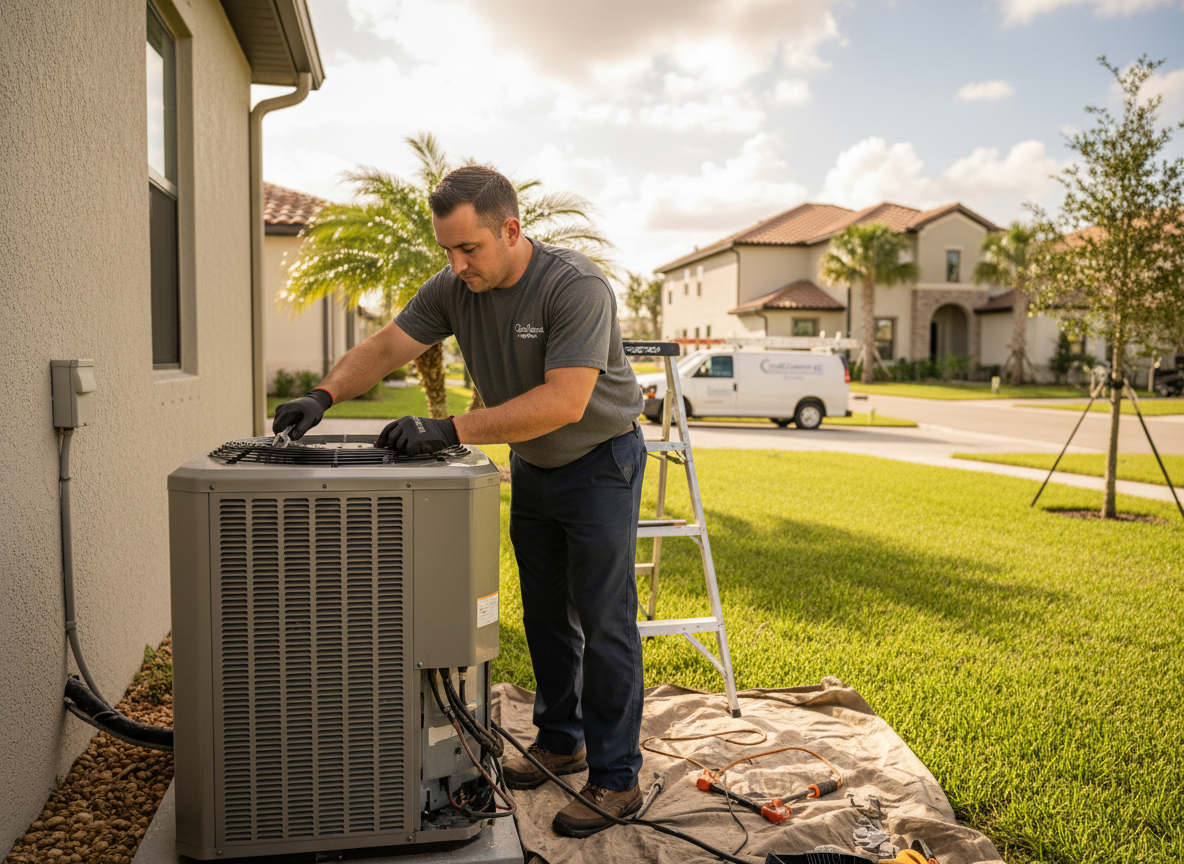
Lakewood Ranch homes in Manatee County often see air conditioning systems pushed hard by prolonged high humidity and afternoon thunderstorms that cause power fluctuations. Technicians frequently encounter frozen evaporator coils from restricted airflow or low refrigerant, especially in two-story residences built in the last twenty years where upstairs returns pull in attic heat. Proper diagnosis includes checking condensate drains that clog quickly with local pollen and checking capacitors that fail after repeated surges.
Newer developments along State Road 70 feature tighter envelopes that trap moisture, forcing units to run longer cycles and wear compressors faster than older ranch-style homes near Lakewood Ranch Main Street. Repair calls commonly involve replacing contactors scorched by lightning-induced spikes or flushing linesets contaminated by previous improper retrofits. Homeowners should expect inspection of both indoor and outdoor sections because the coastal-influenced air here accelerates corrosion on aluminum coils.
Technicians always verify thermostat calibration and blower motor amperage because many Lakewood Ranch properties have variable-speed systems installed during recent renovations. Ignoring these steps leads to short cycling that raises humidity levels inside the home rather than lowering them. Work includes confirming proper refrigerant charge with superheat and subcooling measurements specific to the outdoor temperature at the time of service.
Technician insight
In Lakewood Ranch, the thing that catches most people out with air conditioning repair is how quickly pollen and construction dust from ongoing neighborhood builds clog condensate drains and reduce airflow across coils in homes built after 2005.
Rapid Cycling After Evening Storm
A Lakewood Ranch residence near the golf course experienced short cycling following a thunderstorm. Inspection revealed a tripped low-pressure switch from a partially clogged drain line filled with oak pollen. The line was cleared and the capacitor was replaced. The unit resumed steady operation through the remaining humid season.
How it works
- 1
Initial System Assessment
Technician arrives and reviews symptoms while checking thermostat settings, airflow at vents, and listening for unusual noises from the outdoor unit.
- 2
Diagnostic Testing
Electrical components, refrigerant pressures, and drain lines are tested using gauges and meters to identify the exact failure point.
- 3
Repair Execution
Faulty parts such as capacitors, contactors, or clogged drains are replaced or cleared, followed by system restart and performance verification.
- 4
Final Verification
Temperature split and humidity levels are measured at multiple registers to confirm the repair restored proper operation.
Pricing
Upfront quotes provided on-site before any repair work begins.