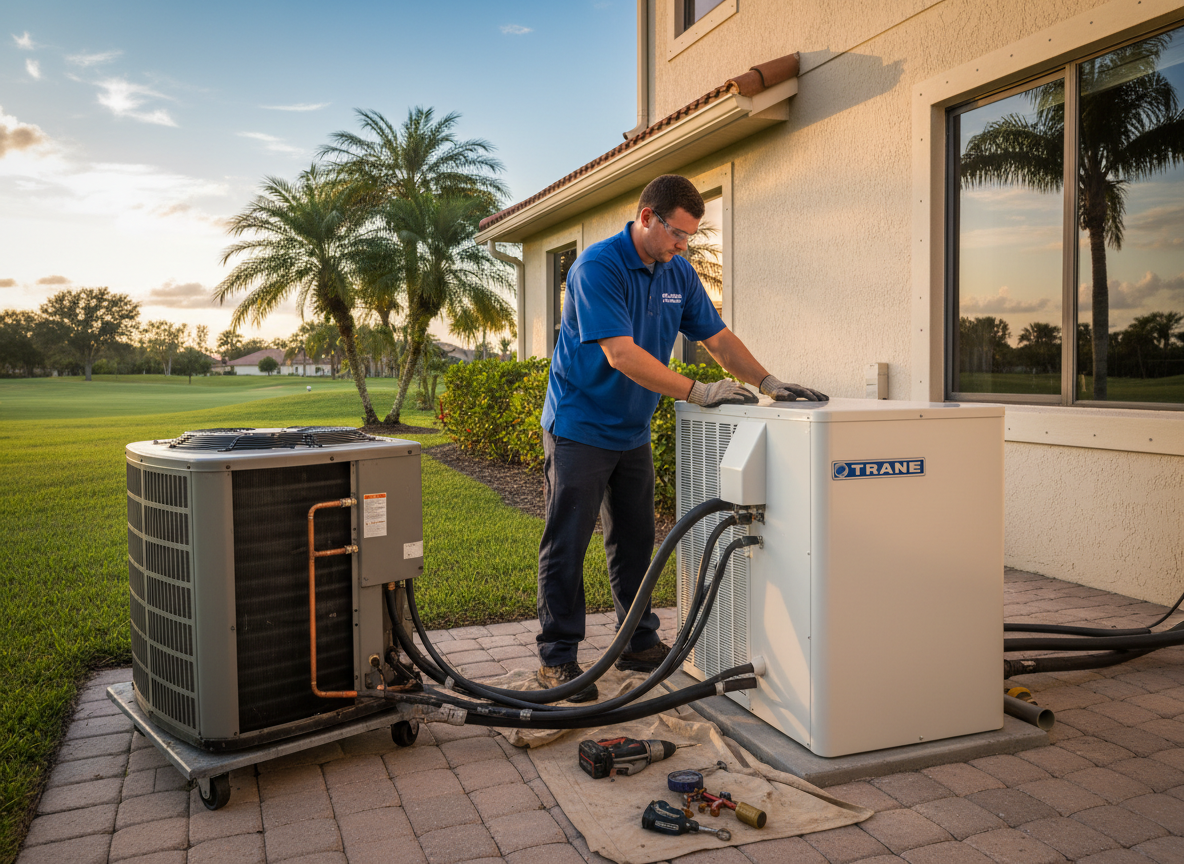
Lakewood Ranch homes built after 2000 often feature open floor plans with long horizontal duct runs in unconditioned attics. These setups lose efficiency quickly when coils corrode from constant 80-plus percent humidity and salt-tinged summer air. Replacement jobs here require upsizing return-air pathways and adding secondary drains to meet current Manatee County mechanical code, especially when swapping older 3-ton units for variable-speed systems that better manage latent loads during daily thunderstorms.
Outdoor condensers in this area sit on slabs that settle unevenly because of sandy soil and occasional heavy rain. Technicians must check pad level and line-set insulation thickness before final placement, or the new unit risks oil return issues within two seasons. In neighborhoods near Lakewood Ranch Main Street or along State Road 70, we also verify that new equipment clears hurricane tie-down requirements without obstructing existing irrigation lines.
Homeowners frequently underestimate the impact of pollen and mold on evaporator coils in this climate. During replacement we install UV lights or enhanced filtration only after confirming static pressure readings, because added restrictions can reduce airflow in the tighter duct systems common in newer Lakewood Ranch construction. Proper commissioning with superheat and subcooling measurements prevents callbacks when afternoon temperatures spike above 92 degrees.
Technician insight
In Lakewood Ranch the thing that catches most people out with hvac replacement is how quickly attic humidity degrades flex duct and coil fins on homes built on the sandy fill lots east of Lorraine Road. Skipping a full static-pressure check before ordering the new unit often leads to short-cycling once the afternoon storms roll in.
Failing unit near Lakewood Ranch Town Center
Homeowner reported weak airflow and high humidity in a 2012 single-story house off Lakewood Ranch Boulevard. We found collapsed flex duct sections and a corroded evaporator coil. Replaced the system with a properly sized variable-speed unit, rebuilt the return plenum, and verified condensate drainage to prevent future attic moisture issues.
How it works
- 1
Site Assessment
Measure existing ductwork, load calculations, and electrical service at the Lakewood Ranch address to determine correct equipment capacity.
- 2
Old Unit Removal
Disconnect and extract the failing system while protecting flooring and landscaping typical of local homes.
- 3
New Installation
Set new air handler or furnace, run line sets, and secure the condenser to code-compliant pads.
- 4
Testing and Handover
Perform full system commissioning, register the equipment, and review maintenance needs with the homeowner.
Pricing
Cost depends on system tonnage, duct modifications, and whether electrical upgrades are required; call for an on-site quote.